In Bundaberg we often see projects hit unexpected delays because the clay soils weren't properly classified before construction started. The region's alluvial and volcanic clays can shift from stiff to plastic with just a small change in moisture. That's where Atterberg limits become critical — they tell us exactly how a soil will behave under load and wetting cycles. Without this data you're essentially guessing the foundation's long-term performance. Our team runs the liquid limit, plastic limit and shrinkage limit tests following AS 1289.3.1.1 and AS 1726, so you get numbers you can trust. We also cross-check results with a granulometry analysis when the soil has significant sand fractions, ensuring the classification is complete from the start.
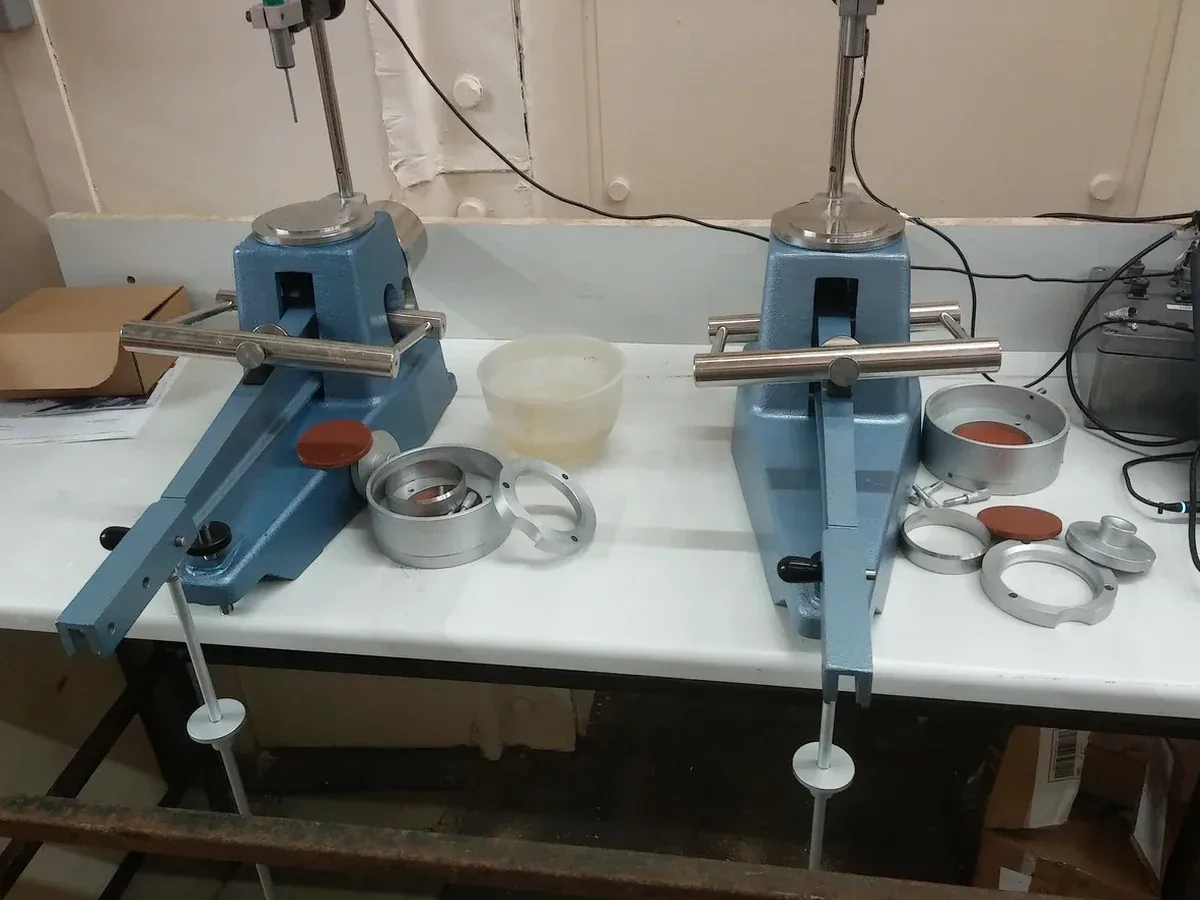
A plasticity index above 35 in Bundaberg clays usually means expansive behaviour — don't assume all clay is the same.
Methodology applied in Bundaberg
Working video
Typical technical challenges in Bundaberg
Compare a site near the CBD with one closer to Bargara — the first may have firm sandy clays with a PI of 15, while the second can hit PI values over 40. That difference changes everything: foundation depth, slab reinforcement, drainage design. If you assume the same soil behaviour across Bundaberg you risk differential settlement or structural cracking. The Atterberg limits give you the numbers to separate low-risk from high-risk zones before you pour concrete.
This service complements our laboratory testing work for a complete project analysis.
Our services
Beyond Atterberg limits we offer a full range of geotechnical tests tailored to Bundaberg's conditions.
Liquid Limit Test (Casagrande Method)
We run the standard Casagrande cup method per AS 1289.3.1.1 to determine the moisture content at which soil transitions from plastic to liquid. Results are reported with flow curve and precision check.
Plastic Limit & Plasticity Index
Thread-rolling method to find the lowest moisture content where soil remains plastic. The plasticity index is then calculated as LL minus PL, essential for USCS classification and shrink-swell assessment.
Shrinkage Limit & Linear Shrinkage
Measures the moisture content at which further drying no longer reduces volume. Critical for Bundaberg clays that crack in dry spells and swell in wet seasons. Results used in slab design per AS 2870.
Quick answers
Why are Atterberg limits important for construction in Bundaberg?
Bundaberg's clay soils vary significantly across suburbs. Atterberg limits classify the soil as low, medium or high plasticity, which directly affects foundation design, slab type and drainage requirements. Without this data you risk heave or settlement that cracks walls and floors.
How much does Atterberg limits testing cost in Bundaberg?
The typical range for a full set (liquid limit, plastic limit and plasticity index) is AU$90 to AU$180 per sample. The final price depends on the number of samples and whether you need shrinkage limit or linear shrinkage added. Contact us for a quote based on your specific scope.
What sample size do I need for Atterberg limits testing?
You need at least 500 grams of disturbed soil per test. We recommend collecting samples from each distinct soil layer identified during site investigation. For a standard residential lot in Bundaberg, 3 to 5 samples usually cover the variation across the site.
How long does it take to get Atterberg limits results?
Results are typically available within 5 to 7 working days after the samples arrive at our lab. If you're in a hurry we can prioritise your samples for a small surcharge — just let us know when you book the service.