Bundaberg sits on a coastal plain where the water table rises within two metres of the surface during the wet season. That shallow groundwater makes landfill geotechnics a discipline where drainage and barrier design cannot be an afterthought. Every new cell or expansion we work on here requires a detailed understanding of how seasonal saturation affects liner performance and slope stability. We have seen what happens when a clay liner sits in perched water for weeks on end – the effective stress drops and the factor of safety against base heave goes with it. That is why our approach always starts with in-situ permeability testing and a careful assessment of the local hydrogeology before we recommend a containment strategy.
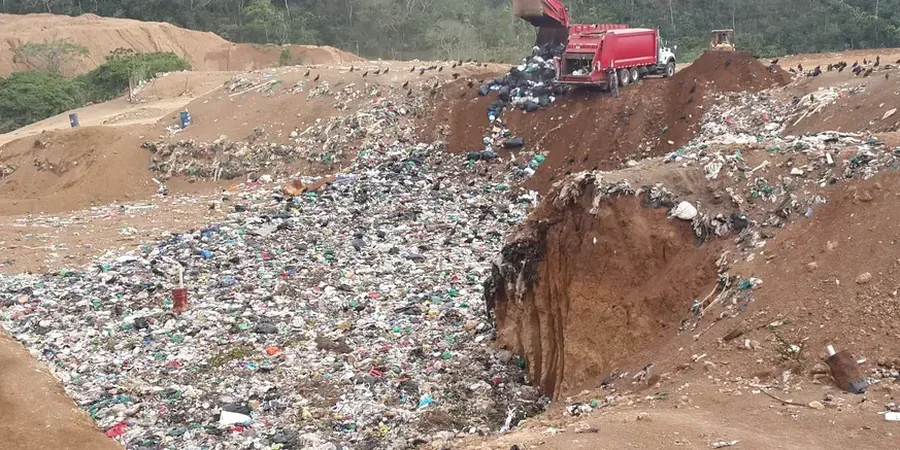
A 0.5 m drop in effective stress during a wet season can double the leakage rate through a compacted clay liner.
Methodology applied in Bundaberg
- Continuous core drilling to 8 m depth to log the natural clay layers beneath the proposed cell.
- Field falling-head tests in standpipes to measure in-situ hydraulic conductivity.
- Triaxial consolidated-undrained tests on liner material to verify shear strength under saturated conditions.
Typical technical challenges in Bundaberg
The biggest operational risk we see in Bundaberg is wet-weather construction of the liner system. If a clay layer is placed and compacted when the moisture content exceeds optimum by more than 3 %, the dry-season shrinkage cracks can turn into preferential flow paths that bypass the barrier entirely. We have had to issue stop-work notices twice in the past three years because the contractor tried to push through a February rain event. The solution is a staged construction schedule with a sacrificial working platform that gets stripped back once the dry season returns. That platform buys time and preserves the integrity of the final liner.
This service complements our laboratory testing work for a complete project analysis.
Our services
We deliver two core landfill geotechnics services tailored to Bundaberg conditions:
Liner System Design & Verification
Field permeability testing, compaction control, shear box and triaxial testing on clay and GCL liners. We certify that the installed barrier meets the regulatory k ≤ 1.0 × 10⁻⁹ m/s requirement.
Leachate Management & Slope Stability
Hydrogeological modelling of leachate mound build-up, stability analysis of waste slopes and liner anchorage, plus drainage layer design using our in-house software.
Quick answers
How long does a landfill geotechnics investigation take in Bundaberg?
A standard site investigation for a new cell – including drilling, field testing, lab work and reporting – takes three to four weeks. If we need long-term consolidation tests on the clay liner material, add another two weeks.
What is the typical cost range for a landfill geotechnics study in Bundaberg?
For a medium-size cell of about 2 hectares, the investigation and design certification ranges between AU$3,360 and AU$11,250. The variation depends on the number of boreholes, depth of drilling and whether specialised triaxial testing is required.
How does the shallow water table in Bundaberg affect liner design?
The water table sits within 2 m of the surface during La Niña events. That reduces the effective stress on the liner and increases the risk of hydraulic uplift. We design with a minimum 0.6 m clay liner plus a geocomposite drainage layer to keep the leachate head below 300 mm.
Do you recommend GCL or compacted clay liners for Bundaberg landfills?
Compacted clay liners are the standard because the local alluvial clays can achieve k < 1.0 × 10⁻⁹ m/s when properly compacted. GCLs are an option for temporary caps or steep side slopes where clay placement is impractical, but we always verify the GCL overlap and hydration conditions.