AS 1726 and AS 4678 set the framework for investigating fill materials, but in Bundaberg the challenge is the variable nature of historical fills. Much of the city's expansion occurred on former floodplains and low-lying areas where uncontrolled fills were placed decades ago. These materials often hide buried organics, loose zones, and moisture-sensitive layers. We combine test pits, SPT, and laboratory compaction tests to map the fill profile. Before designing shallow footings, we also run a consolidation analysis to predict long-term settlement and a dilatometer test to measure lateral stress in deep fills.
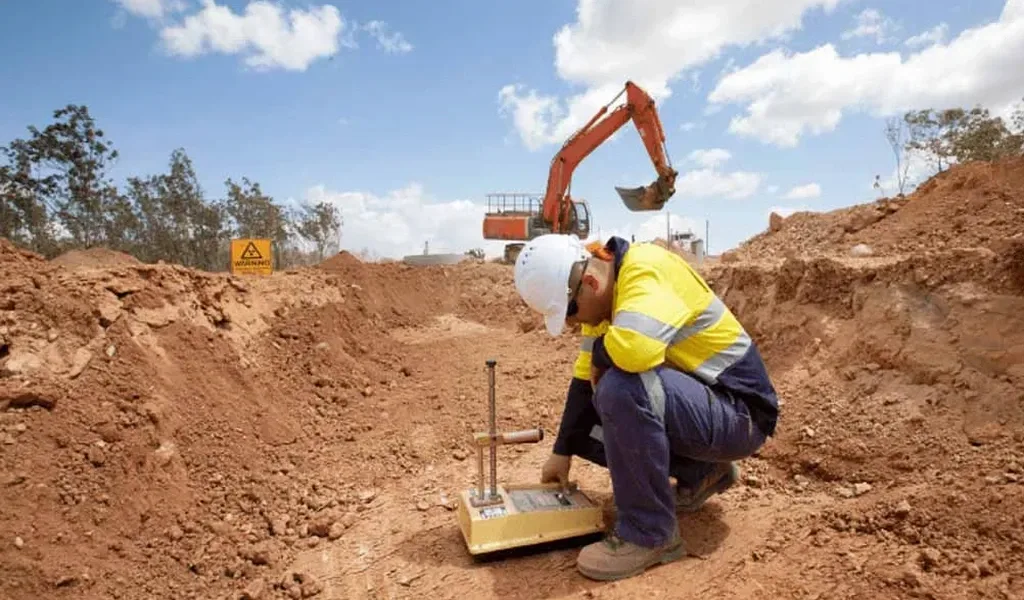
Uncontrolled fills in Bundaberg can settle up to 50 mm over 5 years if compaction targets are missed. Our analysis catches that risk early.
Methodology applied in Bundaberg
- Compaction control using modified Proctor (AS 1289.5.2.1)
- In-situ density tests with nuclear or sand-cone methods
- Collapse potential assessment for fills exposed to wetting
Typical technical challenges in Bundaberg
We often see projects in Bundaberg where fill is placed without proper moisture conditioning. A dry fill might pass density tests but later collapses when wet, dropping the foundation by 30 mm or more. Another overlooked risk is the presence of buried demolition rubble or old tree stumps within the fill. These create voids that can cause sudden differential settlement. We always recommend a program of test pits and dynamic cone penetration before accepting any fill as suitable for foundations on fill analysis.
This service complements our laboratory testing work for a complete project analysis.
Our services
Our foundations on fill analysis in Bundaberg covers two core services tailored to fill conditions:
Fill Compaction Assessment
We review construction records and perform in-situ density tests to verify compaction against project specifications. Where records are missing, we run laboratory compaction curves and re-test field densities to confirm compliance.
Long-Term Settlement Prediction
Using consolidation and creep models calibrated to Bundaberg fill samples, we estimate total and differential settlement over the design life. The report includes allowable bearing pressures and recommendations for Improvement if needed.
Quick answers
How deep does the fill need to be compacted for a house slab in Bundaberg?
For a typical residential slab-on-ground, we recommend compaction to at least 95% MDD to a depth of 1.5 times the footing width. For fills deeper than 2 m, we may specify 98% MDD in the upper 600 mm to control localised settlement.
What tests are used to detect buried organics in old fill?
We use a combination of test pits, auger holes, and visual classification. Organic layers show up as dark, fibrous zones with low blow counts in SPT. Loss-on-ignition tests (AS 1289.4.1.1) confirm organic content above 5%.
Can foundations on fill be designed without Improvement?
Yes, if the fill is less than 1.5 m thick, well-compacted, and uniform. For thicker or suspect fills, we typically recommend dynamic compaction, stone columns, or a raft foundation designed to tolerate up to 25 mm of differential movement.
What is the cost range for a foundations on fill analysis in Bundaberg?
The typical cost ranges from AU$1,240 to AU$4,440 depending on the number of test pits, laboratory tests, and settlement modelling required. A basic residential assessment is at the lower end; commercial developments with deep fills sit at the upper end.