Bundaberg sits on a mix of alluvial and volcanic soils, with the Burnett River cutting through basalt-derived clays and sands. The water table here can sit just a couple of metres down after heavy rain, which directly impacts retaining wall design – hydrostatic pressure builds fast behind the wall if drainage isn’t planned right. In our experience, the key is understanding how the local soils behave under load. We start with a detailed site investigation, often combining test pits with a grouting program if the ground has loose zones or old fill that needs stabilising before the wall goes in. That initial step saves headaches later.
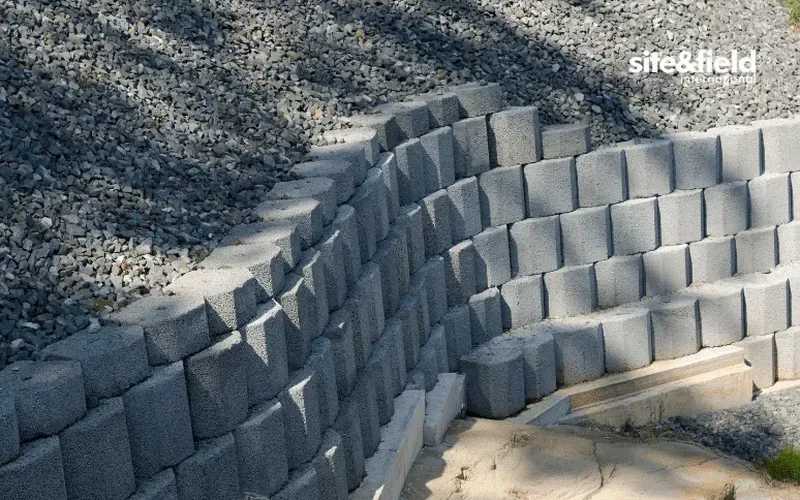
Hydrostatic pressure behind a retaining wall in Bundaberg’s alluvial soils can double the load – drainage design is non-negotiable here.
Methodology applied in Bundaberg
Typical technical challenges in Bundaberg
Bundaberg sits in a region with a 1-in-500-year seismic hazard of about 0.08 g peak ground acceleration per AS 1170.4. That might sound low, but when you couple it with loose sandy soils near the river, there's a real risk of liquefaction-driven lateral spreading behind a retaining wall. We've seen walls shift because the backfill saturated and lost strength during prolonged wet seasons. Our design approach always includes a liquefaction assessment per NCEER guidelines and a drainage layer tied to a proper outlet so the wall doesn't become a dam.
This service complements our laboratory testing work for a complete project analysis.
Our services
Our retaining wall design service in Bundaberg covers the full scope, from initial site investigation to final parameter report. We tailor each stage to the local ground conditions.
Site Investigation & Soil Testing
We drill boreholes and dig test pits to classify the soil profile, measure groundwater levels, and collect samples for lab testing – all under AS 1726.
Parameter Derivation & Design Report
Using triaxial, direct shear, and consolidation tests, we derive friction angles, cohesion, and compressibility values specifically for your wall height and load case.
Drainage & Backfill Recommendations
We specify free-draining granular backfill, filter fabric, and weep holes or a perforated pipe system to keep hydrostatic pressure under control.
Quick answers
What soil parameters are critical for retaining wall design in Bundaberg?
The effective friction angle (φ') and undrained shear strength (su) are the two key ones, since many Bundaberg soils are stiff clays or loose sands. We also need the unit weight and the groundwater level to calculate active and passive pressures correctly.
How much does retaining wall design typically cost in Bundaberg?
For a standard residential wall up to 3 m high, including site investigation and a full geotechnical report, you're looking at AU$1,670 to AU$5,540. Larger commercial walls with deeper boreholes and more lab testing will be at the higher end.
Do I need a geotechnical report for a small retaining wall?
Yes, even for walls under 1 m. Bundaberg's variable soil conditions mean a wall that works in the CBD might fail in Bargara. A simple report with one borehole and a couple of lab tests costs a fraction of rebuilding a failed wall.