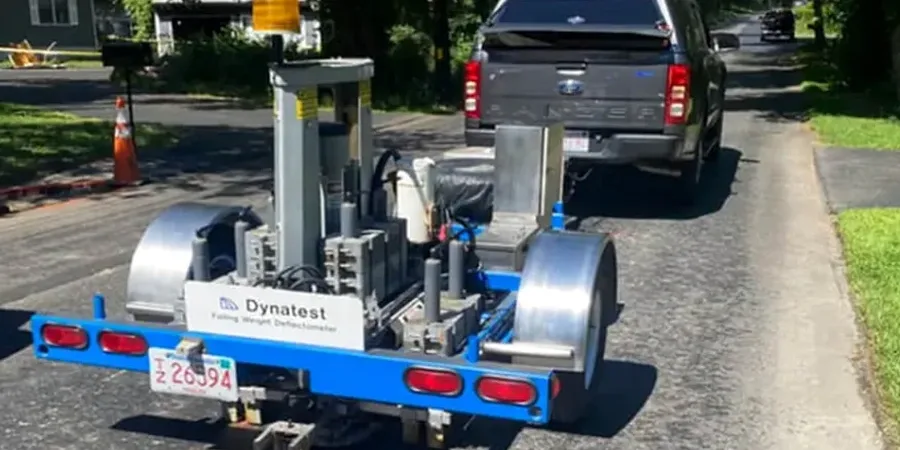
The falling weight deflectometer rolls into position on a Bundaberg roadway, its loading plate settling onto the asphalt surface. This device drops a known weight to measure pavement deflection under controlled impact. The data reveals structural capacity layer by layer. Our team deploys this equipment alongside core sampling rigs to extract intact pavement cores. These samples undergo laboratory testing for thickness, density, and material composition. Bundaberg's subtropical climate accelerates surface deterioration, making accurate evaluation critical before any overlay or rehabilitation. We assess both flexible and rigid pavements using methods aligned with Austroads guidelines. Before mobilising equipment, we coordinate lane closures with local traffic management to minimise disruption. The entire process from field testing to laboratory analysis takes between five and ten working days depending on project scope.
A single road section in Bundaberg may contain three different base courses from decades of repairs. DCP testing profiles strength continuously.
Methodology applied in Bundaberg
Working video
Typical technical challenges in Bundaberg
Pavements in the CBD of Bundaberg differ markedly from those in the outer industrial estates. The older CBD roads often sit on legacy rubbled bases with poor drainage, while newer industrial pavements use engineered granular layers. If the evaluation misses a weak subgrade zone under an apparently sound surface, the overlay will crack within twelve months. The risk is highest where the water table sits within one metre of the surface after heavy rain. We mitigate this by combining FWD testing with boreholes to confirm moisture conditions at depth. Using ensayo CBR on undisturbed samples from the subgrade provides direct strength values for design. Delaying a proper evaluation until after pavement failure forces emergency repairs that cost three to five times more.
This service complements our laboratory testing work for a complete project analysis.
Our services
We offer three core evaluation services tailored to Bundaberg's pavement conditions. Each method provides specific data for structural design or rehabilitation planning.
FWD Deflection Testing
Loads applied at 40, 60, 80, and 120 kN at multiple test points per kilometre. Deflection sensors record bowl shape. Results include layer moduli back-calculated using ELMOD software.
Core Sampling and Laboratory Testing
Extracts 100 mm or 150 mm diameter cores from asphalt or concrete pavements. Tests include bulk density, maximum theoretical density, binder content, and indirect tensile strength.
DCP and CBR Profiling
Continuous DCP soundings at 500 m intervals or closer at distress zones. In-situ CBR calculated from DCPI. Undisturbed CBR samples taken for laboratory verification where subgrade is suspect.
Quick answers
How long does an existing pavement evaluation take in Bundaberg?
Field testing usually takes two to three days for a typical 2 km road section. Laboratory analysis adds another five working days. A full report with overlay recommendations is ready within ten working days from mobilisation.
What is the difference between FWD and DCP testing?
FWD measures the overall structural response of the pavement system under a simulated wheel load. DCP measures the penetration resistance of individual layers. FWD gives layer moduli; DCP gives in-situ CBR profiles. We often use both for a complete picture.
How much does an existing pavement evaluation cost in Bundaberg?
The cost typically ranges from AU$1.840 to AU$5.970 depending on the length of pavement, number of test points, and whether laboratory testing is included. A detailed quote is provided after reviewing project drawings and site access.
Can you evaluate pavements on active roads without full closure?
Yes. We use single-lane closures with traffic control for FWD and coring. DCP testing can be done on shoulders or during off-peak hours. All traffic management plans comply with Queensland Department of Transport and Main Roads requirements.
What causes pavement failure in Bundaberg's climate?
Bundaberg receives over 1000 mm of rainfall annually, mostly in summer. Water infiltration weakens granular bases and causes subgrade softening. Combined with heavy sugarcane trucks, this leads to fatigue cracking and rutting. Proper drainage assessment is always included in our evaluation.