We worked on a road widening project near the Bundaberg CBD where the subgrade was saturated clay extending eight metres deep. Standard fill placement would have taken years to settle. That is exactly the kind of scenario where prefabricated vertical drain design makes the difference between a delayed project and one that stays on schedule. Our team assessed the consolidation parameters on site and specified a triangular PVD grid to accelerate pore water dissipation. The client avoided surcharge delays and the pavement went in on time. For similar soft ground conditions, we often combine this approach with a preload and surcharge strategy to control post-construction settlement.
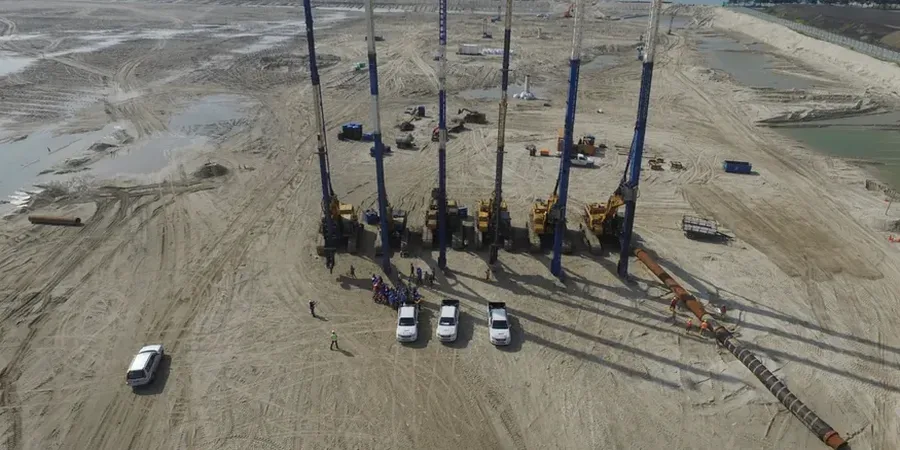
Proper PVD spacing can cut consolidation time from years to months in Bundaberg's soft estuarine clays, saving both schedule and surcharge costs.
Methodology applied in Bundaberg
- Drain spacing typically between 1.0 m and 2.5 m depending on clay thickness
- Installation depth limited by the stiff layer below the soft deposit
- Mandrel size chosen to minimise smear zone disturbance
Typical technical challenges in Bundaberg
The difference between the Woongarra area and the coastal strip near Bargara is striking. Inland clays tend to be overconsolidated from past drying cycles, while coastal deposits are soft and normally consolidated. If you apply a PVD design from a textbook without adjusting for that local variation, you risk underdraining the coastal sites. We have seen projects where inadequate drain spacing led to excess pore pressure during fill placement and caused stability failures. Running a site-specific prefabricated vertical drain design avoids that risk entirely.
This service complements our laboratory testing work for a complete project analysis.
Our services
Our Bundaberg geotechnical team offers four core services related to prefabricated vertical drain design and soft Improvement.
Consolidation testing (oedometer)
Step-loaded oedometer tests on undisturbed tube samples to determine cv, cc, and cr for PVD spacing calculations.
PVD spacing and layout design
Barron's radial drainage analysis with site-specific soil parameters to optimise drain spacing and installation depth.
Settlement monitoring during surcharge
Installation of settlement plates and piezometers to track pore pressure dissipation and verify design assumptions.
Soft clay characterisation
Index properties, Atterberg limits, and natural moisture content to classify the clay profile for drain design.
Quick answers
How long does consolidation take with PVDs in Bundaberg clay?
For a typical 6 m thick soft clay layer with a spacing of 1.5 m, primary consolidation finishes in 4 to 8 months. Without drains the same layer would take 3 to 5 years.
What is the typical cost range for a PVD design package in Bundaberg?
A full prefabricated vertical drain design including oedometer testing and spacing calculations ranges between AU$1,210 and AU$3,660 depending on the number of boreholes and laboratory tests required.
Do I need a geotechnical investigation before PVD design?
Yes. We need undisturbed tube samples and consolidation data to calibrate the drain spacing. A minimum of two boreholes per site is standard for Bundaberg projects.
Can PVDs be installed near existing structures in Bundaberg?
Yes, but we design the mandrel insertion sequence to minimise vibration and displacement. For tight access areas we specify smaller mandrels and reduced spacing.
What happens if the drain spacing is too wide?
Consolidation slows down significantly and residual settlement after construction can exceed 100 mm. That leads to pavement cracking or floor slab distress in buildings.