Bundaberg grew around the Burnett River, with early wharves and sugar terminals built on soft alluvial deposits. Those same floodplain soils now challenge every deep excavation along the river corridor. Sheet pile wall design in Bundaberg needs to account for layered sands, silty clays and a shallow water table that fluctuates with the tide. We have designed temporary and permanent walls for marinas, pump stations and basement car parks here. Before any wall layout we run a site-specific soil investigation, often combining boreholes with a presurometer test to capture the in-situ lateral stiffness that drives the bending moment in the piles.
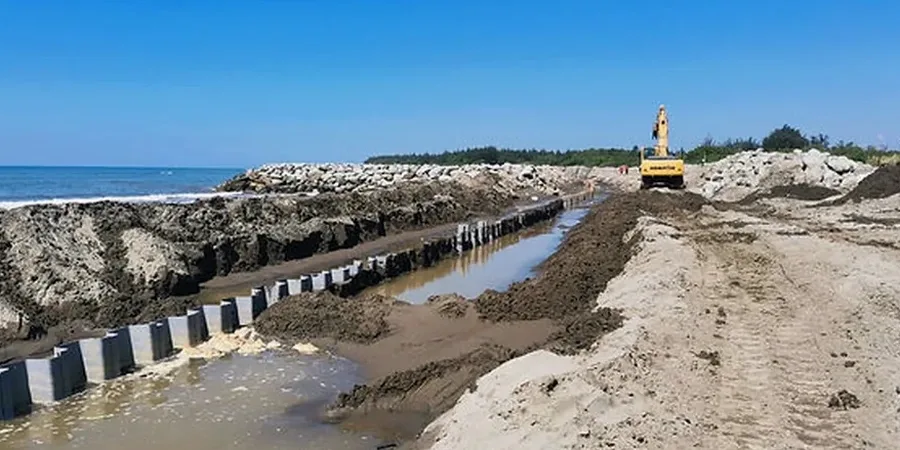
The water table in Bundaberg sits shallow. A sheet pile wall must resist both earth pressure and full hydrostatic head during construction.
Methodology applied in Bundaberg
- Borehole logging to AS 1726 to define soil layering and groundwater conditions.
- Parameter selection based on triaxial and direct shear tests on undisturbed samples.
- Numerical modelling with a software that handles seepage forces and unbalanced excavation stages.
Typical technical challenges in Bundaberg
Bundaberg sits at an elevation of only 17 m above sea level and receives over 1000 mm of rain annually. The Burnett River floods regularly, and after heavy rain the groundwater can rise more than two metres in 48 hours. A sheet pile wall that works during dry months can fail by piping or base heave if the seepage gradient is not controlled. We always model the transient flow with a factor of safety of at least 1.5 on the critical hydraulic gradient. The lesson is simple: never assume the water level you see on day one is the worst case.
This service complements our laboratory testing work for a complete project analysis.
Our services
We offer two main service lines for sheet pile wall design in Bundaberg, each tailored to the project stage and risk profile.
Temporary wall design for excavations
Cantilevered or single-propped walls for shoring up construction pits, trenches and basements. We size the pile section, embedment depth and waler system using limit-state design. All calculations follow AS 4678 and include a 0.5 m scour allowance when the wall is close to the river.
Permanent waterfront wall design
Long-term retaining structures for marinas, boat ramps and flood levees. We add corrosion protection, wave overtopping analysis and a durability plan. The design life is typically 50 years, and we specify either pre-coated piles or a sacrificial steel thickness.
Quick answers
What soil conditions in Bundaberg affect sheet pile wall design?
The main concern is the shallow water table combined with interbedded sands and clays. Loose sands can liquefy under cyclic loading, while soft clays produce high lateral pressures. We run consolidation and triaxial tests on undisturbed samples to get reliable parameters.
How deep should sheet piles be driven in Bundaberg?
Embedment depth depends on the retained height and soil strength. For a 6 m excavation in sandy soils we typically go 4 to 5 m below the excavation base. In clay, the depth increases to control basal heave. We calculate the required toe depth using limit equilibrium and check it against AS 4678.
What is the typical cost range for sheet pile wall design in Bundaberg?
The fee for a complete design package, including site investigation, modelling and certification, ranges between AU$2,540 and AU$8,170. The final figure depends on wall length, soil variability and the number of load cases required.
Can sheet piles be used for permanent flood protection walls?
Yes, they are common for permanent levees and revetments along the Burnett River. We specify a corrosion allowance of 1.5 to 2.0 mm for a 50-year life and often combine the piles with a concrete capping beam to resist debris impact during floods.
Do I need a geotechnical investigation before designing a sheet pile wall?
Absolutely. Without boreholes and laboratory tests you cannot determine the lateral earth pressure, groundwater regime or pile drivability. We always recommend a minimum of two boreholes per 30 m of wall, with SPTs every 1.5 m and undisturbed tube samples in clay layers.