Bundaberg sits on the Burnett River floodplain, where Quaternary alluvium and coastal sands dominate the shallow geology. With an average annual rainfall exceeding 1,000 mm, compaction control becomes critical for any earthwork that must remain stable through wet seasons. Our field density test using the sand cone method delivers in-situ dry density and moisture content directly at the point of placement, following AS 1289.5.3.1. This test is the standard for verifying compaction of granular fills, road subgrades, and trench backfill across Bundaberg. Before we pour concrete or place pavement, we confirm that the engineered density has been achieved. For deeper insight into the bearing capacity of those compacted layers, we often pair this test with a study of SPT to correlate blow counts with relative density.
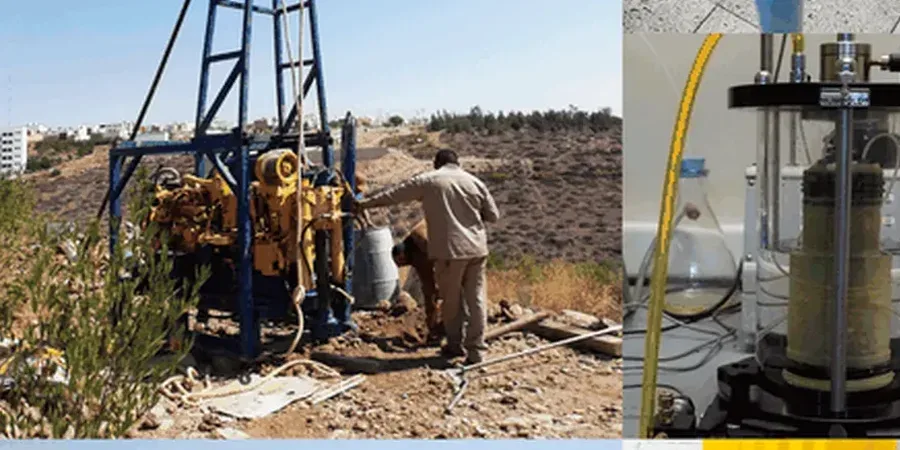
A single sand cone test can identify a 5% compaction deficiency that would otherwise lead to differential settlement under a slab foundation in Bundaberg’s wet subtropical climate.
Methodology applied in Bundaberg
- Dry density (t/m³) vs. maximum dry density from Proctor
- Moisture content (%) relative to optimum moisture content
- Degree of compaction (%)
- Void ratio of the compacted layer
Typical technical challenges in Bundaberg
We use a sand cone apparatus with a 4-litre sand reservoir and a 1.5 mm threaded valve to control flow. In Bundaberg’s humid conditions, the sand can absorb moisture from the air, altering its density. We keep the sand sealed and re-calibrate it every 10 tests or whenever humidity changes. The biggest risk in the field is a poorly seated base plate: if the plate rocks on an uneven surface, the sand leaks laterally and the volume is overestimated. We always hand-level the test area and re-check the seal before releasing sand. Another risk arises when the excavated material contains stones larger than 20 mm; we sieve them out and apply the correction, but if oversize exceeds 30% by mass, the sand cone method loses accuracy and we switch to the nuclear density gauge or a larger test pit.
This service complements our laboratory testing work for a complete project analysis.
Our services
Beyond the sand cone test, we provide complementary geotechnical services for Bundaberg projects. Each is tailored to the local soil conditions, from coastal sands to alluvial clays.
Standard Proctor Compaction
Determines the maximum dry density and optimum moisture content for the specific fill material used on site, providing the baseline for sand cone acceptance.
Modified Proctor Compaction
Higher energy compaction test (AS 1289.5.2.1) for pavement subgrades and heavy-load fills, where higher densities are required to control rutting.
CBR Test (Laboratory & Field)
California Bearing Ratio testing on recompacted samples to assess subgrade strength for road design, often correlated to field density results.
Moisture Content Profile
Depth-specific moisture sampling using a hand auger or Shelby tube, critical for evaluating whether the fill has dried out or become saturated before the next lift.
Quick answers
How many sand cone tests are typically required per lot in Bundaberg?
Most local council specifications and TMR (Transport and Main Roads) guidelines require a minimum of one sand cone test per 250 m² of compacted area per lift, with at least five tests per lot. For critical fills like bridge approaches or tank pads, the frequency increases to one per 100 m².
Can the sand cone test be used on wet or saturated fills?
It can, but the results may be misleading. If the fill is at or near saturation, the degree of compaction often drops below 95% because the moisture exceeds optimum. We recommend drying the surface layer for 24 hours or using a modified Proctor curve to check if the target dry density is still achievable at that moisture content.
What does a field density test cost in Bundaberg?
The typical price for a single sand cone test including a moisture determination is between AU$180 and AU$200 per point. Volume discounts apply for projects requiring 20 or more tests, and we provide a combined rate when paired with Proctor or CBR testing.