Many builders in Bundaberg assume that a standard shallow footing is enough for warehouse slabs or two-storey homes on the alluvial flats near the Burnett River. That assumption often fails when the top 4–6 metres consist of soft silty clay with N-values below 5. The ground simply cannot carry the load without excessive differential settlement. Stone column design offers a proven alternative: installing compacted gravel columns that transfer structural loads to deeper, stiffer layers. We have designed these systems for residential subdivisions and commercial sites across the Wide Bay region, including projects on the outskirts of Bundaberg where the water table sits less than two metres below surface.
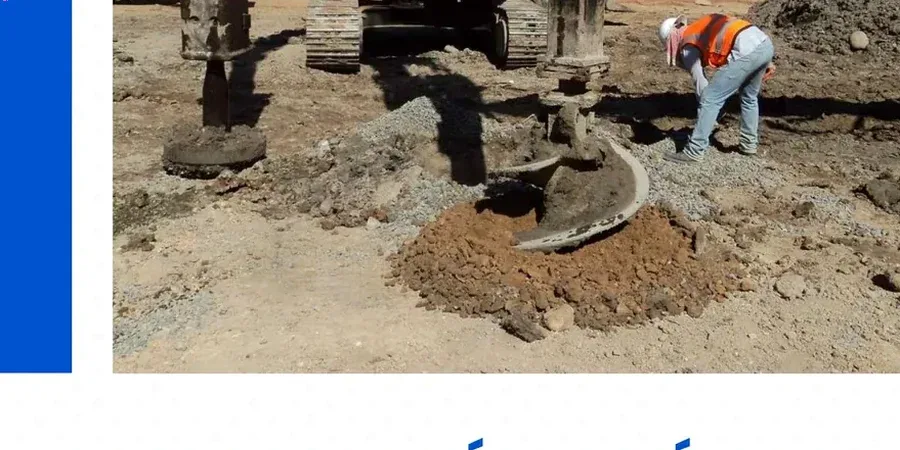
Our stone column designs for Bundaberg alluvial clays target a post-treatment SPT blow count of 12–18 in the upper 5 m, verified by test columns before production.
Methodology applied in Bundaberg
Working video
Typical technical challenges in Bundaberg
A recent project in the Bundaberg CBD involved a two-level commercial building on a site that was originally a tidal wetland. Without stone column design the original footing design would have produced 80–100 mm of total settlement, half of it in the first two years. After installing 350 mm diameter stone columns on a 2.2 m triangular grid to a depth of 6 m, the predicted settlement dropped to 25 mm. The risk of leaving soft ground untreated is not just cracks in masonry — it can break underground drainage lines and tilt floor slabs, leading to costly rectification that easily exceeds the cost of Improvement.
This service complements our laboratory testing work for a complete project analysis.
Our services
We provide two core services around stone column design in Bundaberg, from feasibility study through to construction verification:
Stone Column Feasibility & Design
Review of existing borehole logs, laboratory test results, and groundwater monitoring data. We produce a column layout, depth schedule, and settlement estimate in accordance with AS 4678 and BS 8006. The deliverable includes a construction specification with gravel gradation limits and QA testing frequencies.
Test Column Installation & Proof Testing
We supervise the installation of two to four production-scale test columns on site, measure gravel consumption per metre, and run full-scale load tests using a static plate or instrumented fill pad. Results are compared against the design assumptions before the contractor proceeds with the full column grid.
Quick answers
How does stone column design improve soft soil in Bundaberg?
Stone columns act as vertical drains and stiff inclusions. The gravel column has a much higher modulus than the surrounding soft clay, so it attracts more load and reduces settlement. The vibration during installation also densifies loose sand layers and improves the lateral confinement of the clay.
What is the typical cost range for stone column design and installation in Bundaberg?
For a typical commercial or industrial site in Bundaberg the total cost — including design, test columns, and production installation — falls between AU$2,580 and AU$8,240 depending on column depth, grid spacing, and total treated area. We recommend obtaining a site-specific quotation after the geotechnical investigation is complete.
What site conditions make stone columns unsuitable?
Stone columns are not effective in soils with high organic content exceeding 20 % by mass, or in very soft clay with undrained shear strength below 10 kPa. They also perform poorly if a thick layer of stiff clay or rock is present within the upper 2 m, because the vibrator cannot penetrate the dense layer to reach the soft zone below.
How long does a stone column project take from design to completion?
Design typically takes 5–10 working days after receiving the soil investigation report. Installation of test columns and proof loading adds another 5 days. Production installation proceeds at 20–40 columns per day depending on depth and ground conditions, so a 200-column grid can be finished in 5–10 working days.